The City Phuket Phase 2, Building C
photos on requestPrice on request
Buyers arrive with a rule imported from another market. Callers from the Gulf tell us that in Dubai off-plan is priced above completed stock and resale trades far below it; buyers reading Russian classifieds arrive with a different figure, resale is 20–30% cheaper. We publish neither number, because neither is ours to verify. What we can do is take the Phuket gap apart: it is assembled from six separable things, and several of them say nothing about the quality of the apartment.
One disclosure before the mechanics. We do not currently list resale units and we do not take resale enquiries; the section "What we have and what we don't" explains why. This guide exists to make the market legible, not to route you into a listing of ours.
A developer holds one price list for the building, and it is public. The list follows the construction stage and the sales plan, a sales manager cannot go under it, and by handover it normally stands above its launch level. A private owner sells one apartment once, usually against a deadline: a relocation, a second transaction, an expiring visa, money needed by a date. The discount is often paying for speed of exit rather than for anything about the unit.
Off-plan in Phuket normally comes with an interest-free schedule running to key handover: payments follow construction stages and no bank is involved. A resale seller wants the full amount at registration, and Thai banks generally do not lend to a foreigner without local income and a long-stay visa, so no mortgage bridges the difference. Note what that moves and what it does not. The price per m² is untouched; the capital you commit before handover is not. Payment structures are covered in our guide to developer instalment plans in Phuket.
An apartment handed over a few years ago carries the traces of use: air conditioning, plumbing, surfaces, appliances. A humid tropical climate accelerates all of it, and what photographs well often costs money once you stand in the room. Furniture deserves its own line: new and inside the price in a new build, several rental seasons old in a resale, so price it at residual value rather than as a gift. Get a refurbishment quote before the deposit — it comes out of the discount you came for.
Thai law caps foreign ownership at 49% of a condominium's saleable area. A unit once registered to a foreign owner stays inside that quota, so reselling it to another foreigner needs no new slot. If the seller is a Thai owner, the unit sits in the Thai 51%, and registering it to you in foreign freehold works only while the building still has quota free. No free quota means leasehold: 30 registered years with renewals written into the contract, and reselling a lease is an assignment on that contract's terms. Some of the cheapest resale listings are cheap for exactly this reason. The condominium juristic person keeps the register and issues the written answer.
At registration the Land Department charges a transfer fee of 2% of the official appraised value; how buyer and seller split it is contractual, and halving it is common practice rather than a rule. Seller-side taxes sit on top: specific business tax at 3.3% of the higher of contract price or appraisal, or stamp duty at 0.5% where SBT does not apply, plus income-tax withholding. SBT and stamp duty are alternatives on the same taxable sale, not additions. A developer costs this block in advance; in a private sale it stays negotiable, and a seller who expects to carry it prices it in. Rates and sources are set out in our guide to taxes and costs when buying property in Thailand.
One cost disappears on a resale. The sinking fund is a one-time contribution collected from the first buyer at handover and is not charged again when the unit changes hands; only a vote of the co-owners can replenish it. Working the other way, a new-build buyer also pays meter registration and usually a year of CAM in advance, so a developer price list is not the final figure either.
Purchase cost calculator
| Property price | THB 8,000,000 |
| Transfer fee: 50% of a 2% fee | THB 80,000 |
| Sinking fund | THB 27,000 |
| Total of included items | THB 8,107,000 |
Freehold purchase example: appraisal is assumed equal to price, the baseline fee is 2% and the buyer pays half. Enter the Land Office valuation, applicable rate and your contractual split. Concessions are not detected automatically. Excludes seller taxes, maintenance, meters, furniture and legal fees; not a lease registration calculator.
Two buyers read the same advertisement differently. Buyers from the Gulf and North America price the whole unit; European buyers price the square metre. Both are legitimate, and the 20–30% claim usually survives only one of them. Run the comparison through this list first.
A buyer put that to us in as many words, and it is the right question for a seller. Sometimes the answer is dull and fine: the owner is leaving and wants a clean exit. Sometimes it is the quota, a short remaining lease, an interior nobody wants to refurbish, or a building where dozens of identical units are listed at once and none of them moves. A seller with a clean answer has the documents behind it; a seller who answers with the expiry date of a discount has not answered.
| What you are comparing | New build from the developer | Resale from a private owner |
|---|---|---|
| Price | One published list, tied to construction stage | A personal price, tied to the seller's deadline |
| Payment | Interest-free instalments to key handover | Full amount at registration |
| Condition | New finishes, furniture package inside the price | Several seasons of wear; furniture at residual value |
| Timing | Wait for completion, with slippage risk | Keys today |
| Freehold | Quota allocated by the developer in advance | Depends on the seller and on free quota in the building |
| Sinking fund | Paid at handover | Already paid by the previous owner |
| Rental income | Starts after completion and letting | Possible from month one if a tenant is in place |
The general document list — what to ask a seller, what the deposit agreement has to say, how a refund works — is in our guide on what to check before paying a deposit on a Phuket condo, and it applies here in full. Below are only the items a resale adds.
Plainly: since September 2026 resale units have been off our shelf at the request of the catalogue owner, because some may already have sold and stale cards confuse a catalogue more than they help it. The agency is not working on resale in this period, so we do not collect resale enquiries and do not promise a resale search. If resale is what you want, we will say so rather than improvise a shortlist.
What we do have: 571 listings in Phuket across 189 developments, entry from THB 2.1M and a median asking price of THB 10.2M. Every price comes directly from the developer with the date it was confirmed, and the video was shot by us on site. Found a resale unit and want to test the gap? Send it over. We will price both deals in one table — payment schedule, fees, seller-side taxes and the cost of bringing the unit back to standard.
Catalogue data ·
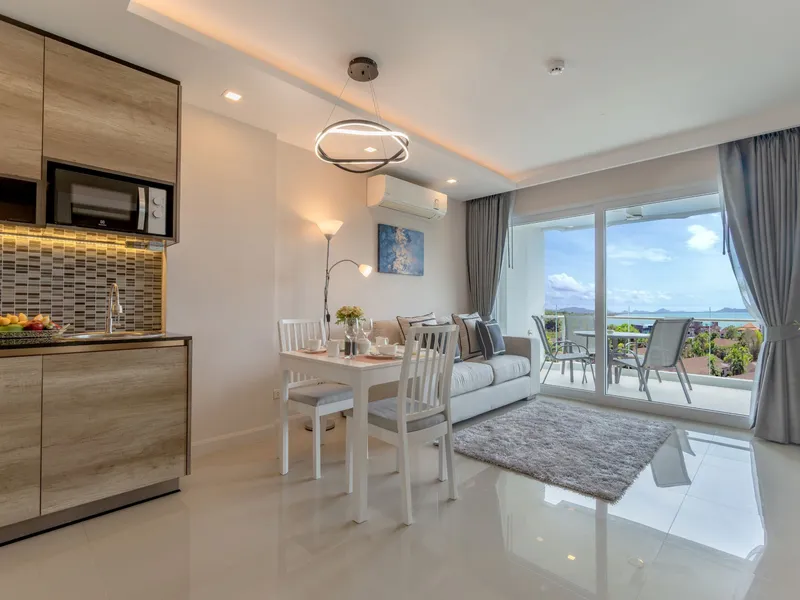
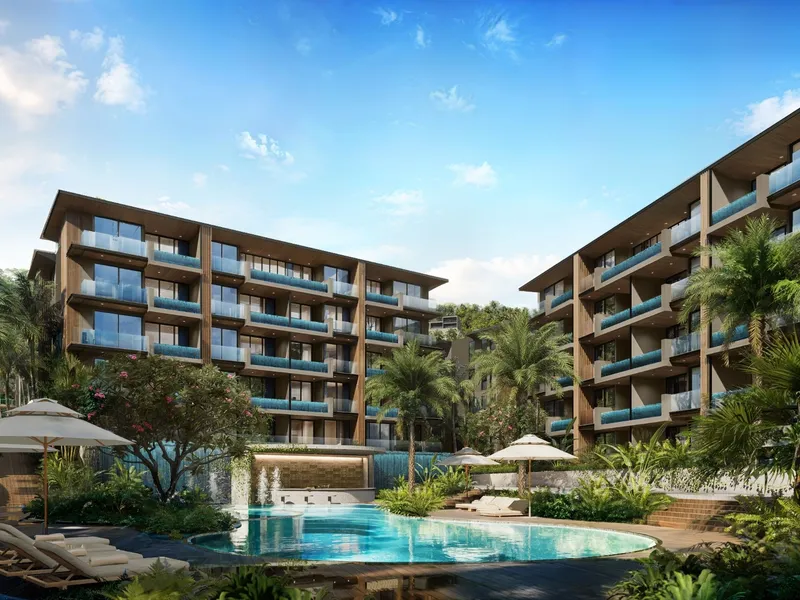 Developer render
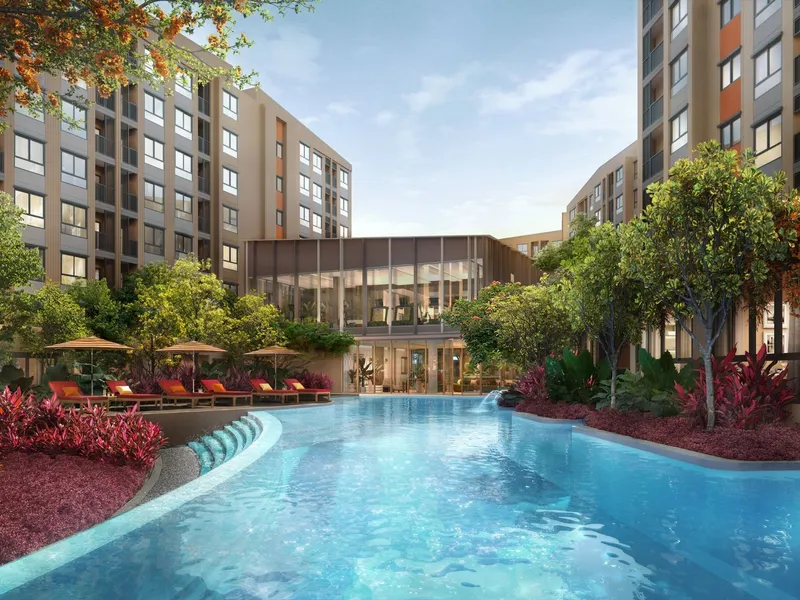 Developer render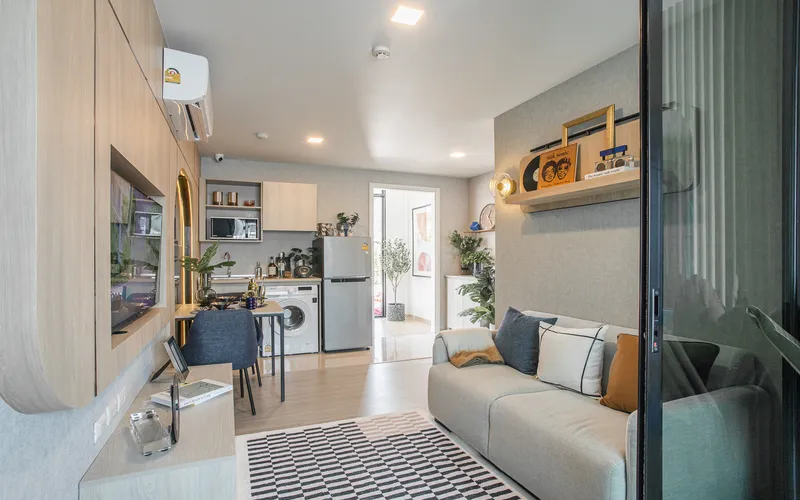
Fee and tax rates here are baseline figures, not a quote for your transaction: relief, the seller's status and the holding period are for a Thai adviser to confirm. The "20–30% cheaper" expectation is quoted as something buyers tell us, and the same goes for what callers report about Dubai. We run no statistics of our own on completed Phuket resale transactions.
That expectation comes from classified sites, and we publish no figure of our own: a credible gap compares completed transactions, not two advertisements. The gap is real, but it is built from the seller's deadline, wear on the unit, the residual value of furniture, the quota status and who carries the fees. Normalise both prices to the same floor area, the same title and the same exchange-rate date, and it usually narrows.
Buyers tell us that is how the Gulf behaves; we have not measured it and will not quote it. The structural difference here is the developer's interest-free plan running to handover, which has no equivalent on the Phuket resale market. That plan changes the capital you commit now rather than the price per square metre, which is why the same two listings look different to a buyer pricing the whole unit and to one pricing the metre.
As a rule, no. Interest-free instalments are a construction-period instrument offered by developers and they close at handover. A private seller expects the full amount at registration, and Thai banks generally do not lend to foreigners without local income and a long-stay visa, so the balance has to come from your own funds.
Then freehold is not available for that unit and the route left is leasehold: 30 registered years with renewals as written into the contract. A unit already registered to a foreign owner keeps its place in the quota and passes to the next foreign buyer without a new slot. The condominium juristic person maintains the register, and its written answer belongs before the deposit.
The transfer fee is 2% of the Land Department's appraised value and the split is whatever the contract says; halving it is common practice, not a rule. Seller-side taxes are calculated separately: SBT at 3.3% or stamp duty at 0.5%, plus income-tax withholding. SBT and stamp duty are not charged together on the same taxable sale. Settle the allocation in writing before any money moves.
No. It is a one-time contribution collected from the first buyer at handover and calculated per square metre. It is not refunded to the seller and not re-charged to you; the fund can only be topped up by a vote of the co-owners, which is a good reason to read the meeting minutes before you commit.
Not at the moment. Resale units were taken off our catalogue in September 2026 at the request of the catalogue owner, since some may already have been sold, and the agency is not handling resale in this period. We work on new builds. If you have found a resale unit elsewhere, we will price it against a comparable new build so the gap is visible in numbers.
We will answer your questions on this topic and send a shortlist of properties for your budget.