Laguna Beach Residences Seashore
photos on requestPrice on request
Developer installment plans in Phuket are interest-free payment schedules offered on off-plan property: instead of paying the full price at once, the buyer pays the developer in stages while the project is built. The standard shape is a reservation fee that takes the unit off the market, a contract payment of around 30 percent on signing, a series of instalments tied to construction milestones, and the balance at handover. No bank is involved and no interest accrues. Many of the 189 projects in the Aperwind catalogue offer instalments until key handover; exact schedules differ by developer and are available on request.
Catalogue data ·
An installment plan is not a loan. The developer extends payment terms on its own inventory, so there is no underwriting, no credit history check and no debt registered against the buyer. That is precisely why the format matters for foreign purchasers: Thai banks lend to non-residents only in narrow circumstances, and a staged schedule from the developer is, in practice, the main financing instrument available on the island. The trade-off is equally simple — the plan runs only while the project is under construction. Once the building is finished and ownership is transferred, the price must be fully paid.
Most Phuket schedules follow the same skeleton, with percentages and milestone counts that shift from project to project.
| Stage | When it happens | What is typically paid |
|---|---|---|
| Reservation | Day one; the unit is taken off the market | A fixed fee, later deducted from the price |
| Contract | Usually within two to four weeks of reserving | Around 30% on signing the sale and purchase agreement |
| Construction milestones | Foundation, structure, roofing, finishing | Several instalments spread across the build |
| Handover | Final inspection and key transfer | The remaining balance, followed by title registration |
The earlier a project is in its cycle, the longer the schedule: a launch-stage development may spread payments across two years or more of construction, while a building nearing completion compresses the same stages into months. Read the milestones carefully — a well-drafted contract ties each payment to certified construction progress, not to calendar dates, so the buyer is never paying ahead of the concrete.
For foreign buyers the comparison is short. Thai retail banks rarely mortgage property to non-residents, and where financing exists it comes with conservative terms and heavy documentation. A developer schedule replaces that entire process: no application, no lender's valuation, no interest cost. What it does not offer is a long horizon — the price is fully paid by handover, within the construction window rather than over decades. Buyers remitting funds from abroad should also plan the paper trail: for a freehold condominium in the foreign quota, purchase funds must arrive from overseas and be documented with a Foreign Exchange Transaction form, and with instalments that means several inward transfers, each properly referenced to the purchase.
| Developer installments | Bank mortgage | |
|---|---|---|
| Interest | None on standard plans | Market rate for the life of the loan |
| Approval | None — terms are contractual | Underwriting, income and residency checks |
| Availability to foreigners | Broad on off-plan projects | Limited and case-by-case |
| Term | The construction period | Long-term amortisation |
| Property type | Off-plan, under construction | Usually completed property |
The scheduled instalments cover the price of the unit; the closing costs arrive at registration. The main statutory item is the transfer fee of 2 percent of the appraised value, payable at the Land Office; how it is split between developer and buyer is set in the contract, so check the clause before signing rather than at handover. For foreign-quota freehold, the FET documentation assembled during the payment period becomes the evidence file for registration. A full breakdown of purchase costs is in our guide to buying property in Phuket, current price levels are in the Phuket price guide, and the calculator below estimates the closing bill for a specific budget.
Purchase cost calculator
| Property price | THB 8,000,000 |
| Transfer fee: 50% of a 2% fee | THB 80,000 |
| Sinking fund | THB 27,000 |
| Total of included items | THB 8,107,000 |
Freehold purchase example: appraisal is assumed equal to price, the baseline fee is 2% and the buyer pays half. Enter the Land Office valuation, applicable rate and your contractual split. Concessions are not detected automatically. Excludes seller taxes, maintenance, meters, furniture and legal fees; not a lease registration calculator.
An interest-free schedule shifts the analysis from cost to counterparty. The buyer is effectively pre-paying a company to deliver a building, so the quality of that company matters more than the shape of the plan. Six checks cover most of the risk.
The Phuket catalogue currently lists 571 properties across 189 projects — 148 villas and 418 apartments — with entry prices from THB 2.1M and a median of THB 10.2M. Bang Tao is the deepest market with 186 listings at a median of THB 12.3M and around THB 140k/m²; Rawai offers 53 listings at a median of THB 8.0M, Kamala 42 at THB 11.3M, and Nai Harn 18 at THB 11.0M. The area guides under /areas/phuket cover each location in detail, and the new-build hub at /complexes/phuket collects every project with direct developer prices and completion dates.
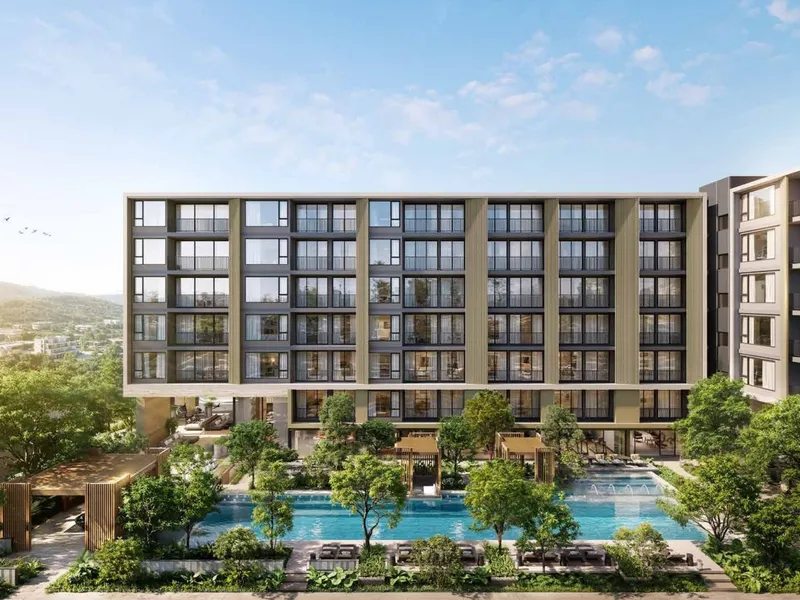 Developer render
.webp)
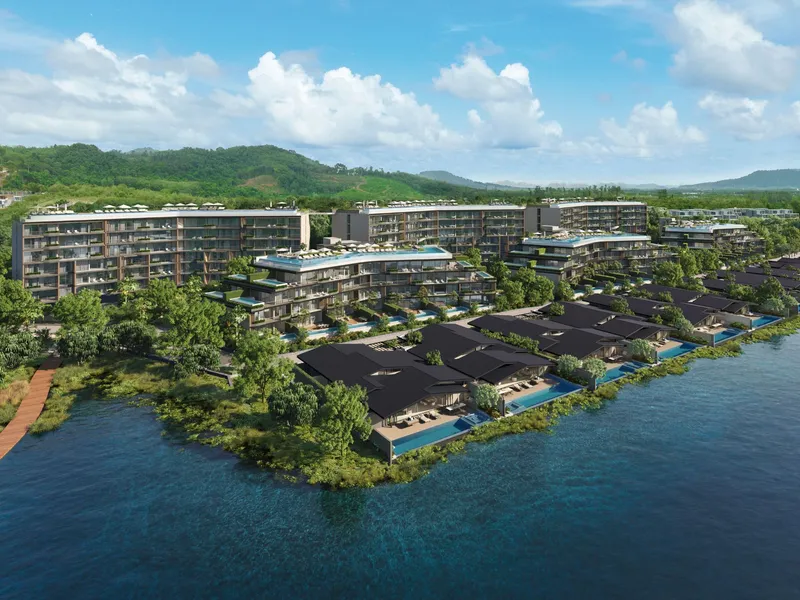 Developer render
Payment schedules are not published as standard catalogue fields because developers revise them by project and by stage of construction. If a shortlisted unit fits your budget on staged payments, request the current plan — we obtain the schedule directly from the developer, together with the contract terms that determine what the plan is actually worth.
On standard off-plan plans, yes — the developer spreads the list price over the construction period without charging interest. There is no lender in the transaction, so there is no rate. What varies is the split between stages and any discount offered for paying a larger share earlier; both are set in the sale and purchase agreement.
The typical entry is a fixed reservation fee followed by a contract payment of around 30 percent of the price on signing the sale and purchase agreement. The remainder is split across construction milestones, with the balance due at handover. Exact percentages differ by project and are available on request.
Rarely. Thai banks lend to non-residents only in limited circumstances and on conservative terms, which is why developer schedules serve as the main financing route for foreign buyers of off-plan property. Buyers who need long-term leverage usually arrange it in their home jurisdiction rather than in Thailand.
The sale and purchase agreement governs it: most contracts set a grace period, late-payment penalties and, ultimately, cancellation terms that determine how much of what you have paid is refundable. Read those clauses before the first transfer — differences between developers are wider on penalties than on prices.
Yes. A condominium can be registered freehold to a foreigner within the building's 49 percent foreign quota, provided the purchase funds arrive from abroad. With a staged schedule that means several inward remittances, each documented with a Foreign Exchange Transaction (FET) form referencing the purchase, so the evidence file is complete at registration.
Not by default — escrow is voluntary in Thailand and most projects do not use it. Ask each developer directly. Where there is no escrow, the practical protections are the developer's delivered track record, milestone-linked payments verified against construction progress, and clear refund terms in the contract.
On the standard structure, no: the balance is settled at handover and title is registered after the final payment. Post-handover terms exist as exceptions negotiated with individual developers, and any such arrangement should be confirmed in the contract rather than assumed from marketing materials.
We will answer your questions on this topic and send a shortlist of properties for your budget.