Laguna Beach Residences Seashore
photos on requestPrice on request
Buying in Thailand is easier than paying for it. The transaction itself takes a few days; getting the money from your home bank to the developer's account takes anywhere from a week to six weeks, and in our deals almost every delay happens here rather than in the legal part. This guide is about the route the money takes: how a transfer has to arrive for the Land Office to register full ownership in a foreigner's name, which routes work in 2026, what paying in crypto actually does to your registration, and how to pay a construction instalment plan while living somewhere else. Ownership structures, the contract and the registration procedure are covered separately in «How to buy property in Thailand».
A foreigner may hold a condominium unit in full ownership — freehold — within the 49% foreign quota of a building's residential area. One condition of that registration is proof that the money came from abroad in foreign currency and was exchanged into baht inside Thailand. The document that proves it is the FET, the Foreign Exchange Transaction form, issued by the receiving Thai bank. Without it the Land Office will not register freehold in a foreign name. This is not a paper you can produce later: the registration simply does not happen, and by then the developer already has your money.
Leasehold — a 30-year registered lease with renewals — carries no such requirement. So the question «how does the money arrive» is not something to settle after choosing a unit; it belongs in the same conversation, because the ownership form and the payment route are tied together.
The bank issues a FET form for an inbound transfer of USD 50,000 or more, or the equivalent in another currency. Below that threshold — and instalment payments are almost always below it — the Thai bank will issue a credit advice, sometimes called a Foreign Exchange Confirmation, on request. It certifies exactly the same facts: foreign currency arrived, it was converted into baht, and the stated purpose was this. The Land Office accepts either document.
Request the document for every single transfer, and request it immediately while the transaction is fresh. Banks can retrieve it from the archive months later, but that means a two-week wait and a fee — usually right when your registration date is already booked.
If your bank has straightforward correspondent relationships, this is the whole story: send, wait a few days, collect the document. Buyers from countries where correspondent banking is restricted — Russia is the case we deal with most often — face a different reality. The transfer is not illegal, but it passes through correspondent banks that apply their own compliance rules: some payments arrive within a week, some come back after two or three weeks with no useful explanation, some sit in a source-of-funds review. Building a deal on that single route is risky, because a returned payment does not move the contractual deadline.
This is the most common route among our buyers who cannot send money directly: a personal account in the UAE, Kazakhstan, Armenia, Kyrgyzstan, Georgia, Serbia or Turkey, funded from home and then wired to Thailand as an ordinary transfer. Opening one takes between a day and several weeks and nearly always requires a visit in person. The bank will ask about the source of funds, and the answer has to be backed by paper: income statements, a sale contract, account statements, documents on a business sale. Assemble them before you open the account, not after the first compliance query.
You will be asked the same question a second time, by the Thai bank on the inbound transfer. The answer must match what you told the first bank and be supported by the same documents.
Thai banks open accounts for foreigners holding a long-stay visa; some will do it against a rental agreement and a letter from an agency. Paying instalments from your own Thai account is convenient, and the card solves everyday life on the island. One detail matters: for your registration paperwork to hold, every top-up of that account has to arrive as foreign currency from abroad. Domestic Thai transfers, cash deposits and money-changer exchanges do not exist as far as the Land Office is concerned.
Phuket developers increasingly accept USDT — normally not directly, but through an exchange house that converts the crypto and credits baht to the seller's account. There is one limitation and it decides everything: such a payment creates no inbound currency transfer, which means no FET form and no credit advice. For leasehold that changes nothing. For freehold in a foreign name it closes the door completely.
The workable pattern is therefore mixed: the reservation and part of the instalments in crypto, and the payment that the freehold registration will rest on sent as an ordinary bank transfer of the required amount. Before you count on it, get written answers from the developer to three questions: do they accept crypto, through which exchange house, and which payment will they process as a currency transfer. A verbal «sure, many people do it» is not enough here.
One more thing, about the rate. The exchange house takes a spread, and on the size of a property payment it is visible: one and a half to two per cent against the exchange rate on THB 8 million is THB 120,000 to 160,000. Ask for the rate on the day of payment, not for «roughly market».
The payer does not have to be the buyer: a parent, a spouse, your own company. Developers accept this when the payer is named in the contract or the payment comes with a letter of explanation. The complication lies elsewhere: the bank issues the FET in the name of whoever sent the money, while the Land Office wants to see the future owner's name on it. The gap is closed with documents — a letter of purpose from the payer, a deed of gift, sometimes a power of attorney. Settle it in advance with the developer's lawyer, not on registration day when the queue number is already taken.
| Step | Usual time | What derails it |
|---|---|---|
| Opening a third-country account | 1 day to 3 weeks | in-person requirement, refusal by nationality, incomplete source-of-funds file |
| Wire to the Thai bank | 2–10 business days | correspondent bank compliance query, wrong beneficiary details |
| Crediting and conversion into baht | 1–2 days | purpose line without the unit number and project name |
| Issuing the FET or credit advice | 1–5 days | nobody requested it right after the funds landed |
The most frequent failure in that table is not about money at all, it is about paper. The transfer arrives, the unit is paid for, everyone is pleased, and no one asks for the inbound-currency document. It surfaces at registration, when nothing can be changed.
The second most frequent is the purpose line. The bank copies that field verbatim; if it reads «family support» or simply «investment», the Land Office may refuse to connect the payment to the property, and tying the two together then takes separate correspondence between the bank and the developer.
A developer's schedule is typically four to eight payments spread over two or three years of construction. Each of them should ideally be a separate currency transfer with its own supporting document; put them in one folder as you go rather than collecting them before the deal. Instalment terms, reservation amounts and typical schedules are covered in a separate guide — the point here is different: on an interest-free plan there is no reason to pay ahead of schedule.
A discount for paying in full is another matter: Phuket developers offer between three and seven per cent for it, and on real numbers that can outweigh the alternative. When you weigh it, remember that Thai off-plan sales have no escrow: the money goes straight to the developer, and a unit paid for in advance is your risk, not a bank's. The further away the completion date, the more careful you should be with early payment.
A foreigner may sell and repatriate the proceeds. The amount a bank will send out without further questions is checked against what you brought in, and it is evidenced by the very same FET forms and credit advices you collected when buying. That is their second function, deferred by years. Keep the folder until you sell, not until you register.
On top of that comes the tax side: the withholding at transfer, the income calculation and the holding period are covered in the guide on property taxes in Thailand. The repatriable amount is what remains after those, not before.
Purchase cost calculator
| Property price | THB 8,000,000 |
| Transfer fee: 50% of a 2% fee | THB 80,000 |
| Sinking fund | THB 27,000 |
| Total of included items | THB 8,107,000 |
Freehold purchase example: appraisal is assumed equal to price, the baseline fee is 2% and the buyer pays half. Enter the Land Office valuation, applicable rate and your contractual split. Concessions are not detected automatically. Excludes seller taxes, maintenance, meters, furniture and legal fees; not a lease registration calculator.
We are neither a bank nor a payment agent: the money goes straight from you to the developer and never through us. What we do is find out the account details, the exact purpose wording and the developer's position on crypto or third-party payment in advance, and then check that the bank issued you the right document. For any unit in the catalogue — 571 properties on Phuket at the moment — those payment terms can be obtained before you reserve, together with the developer's price list.
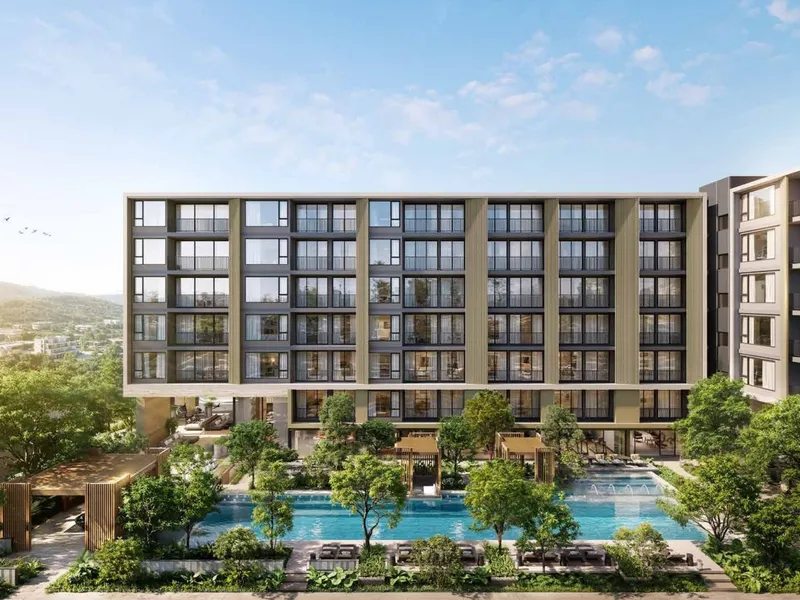 Developer render
.webp)
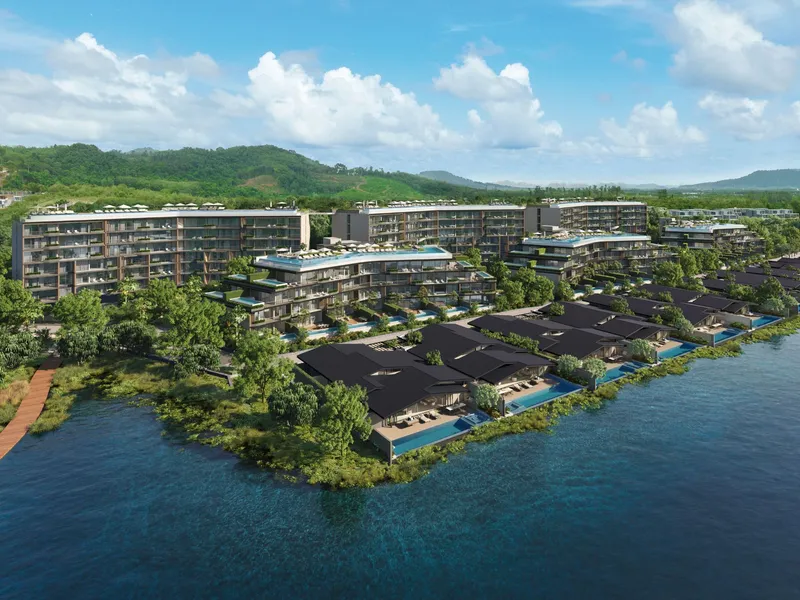 Developer render
If your bank has normal correspondent relationships, yes, and that is the simplest route. Where correspondent banking is restricted the payment is still legal but unpredictable: some transfers arrive in a week, others come back after two or three weeks or sit in a source-of-funds review. In that case keep a fallback route through a third-country account, because a returned payment will not move the contractual deadline.
The Foreign Exchange Transaction form is a Thai bank document certifying that foreign currency arrived and was converted into baht. It is issued on transfers of USD 50,000 and above; for smaller amounts the bank issues a credit advice on request, which serves the same purpose. Without one of these the Land Office will not register freehold ownership in a foreigner's name.
Some developers accept USDT through an exchange house. But a crypto payment creates no inbound currency transfer, so it produces neither a FET form nor a credit advice. That is harmless for leasehold and fatal for freehold in a foreign name. The practical answer is a mixed payment where the amount backing the registration is sent by bank transfer.
No. A relative or your own company may pay, provided this is reflected in the contract. The bank will issue the supporting document in the payer's name, while registration needs yours, so the gap is closed with a letter of purpose or a deed of gift. Agree the wording with the developer's lawyer before sending anything.
Two to ten business days when nothing intervenes. Compliance checks are what stretch it: either the correspondent bank or the receiving bank may ask for source-of-funds documents, which pushes it to two or three weeks. An error in the beneficiary details or the purpose line adds as much again.
The money arrives and the unit is paid for, but there is no FET: the form certifies the conversion of foreign currency into baht inside Thailand. For leasehold that is not critical; for freehold registration it is. Send currency and let the Thai bank convert it.
Each instalment is a separate transfer, and each deserves its own bank confirmation. Many buyers open a Thai account and pay from it, topping it up with currency transfers from abroad. The one thing to avoid is topping it up by domestic Thai transfer — those do not count as inbound currency.
Through the same bank and on the same paperwork: the amount you may repatriate without extra questions is checked against what you brought in, evidenced by the FET forms and credit advices from the purchase. That is why they are kept until the sale. The tax side is settled first and is covered in the guide on property taxes in Thailand.
We will answer your questions on this topic and send a shortlist of properties for your budget.