Laguna Beach Residences Seashore
photos on requestPrice on request
Phuket property makes money in two ways: rental income while you hold, and the difference between entry and exit price. Neither is guaranteed, and any project that quotes a precise yield before you have modelled occupancy, fees and ownership costs is selling, not calculating. What you can control is the entry point and the cost structure. As of September 2026 our catalogue tracks 571 Phuket properties at direct developer prices, starting from THB 2.1M with a median of THB 10.2M. This guide covers where returns actually come from, the three rental strategies used on the island, how guaranteed-rent programmes work in practice, and the arithmetic to run before any deposit is transferred.
Total return has two components. The first is rental income: Phuket runs on tourism, with a pronounced high season roughly from November to April, so short-term income is seasonal by construction and depends on location, product quality and the operator who fills the calendar. The second is capital appreciation, which on Phuket is driven less by broad market swings than by the specific project — buying off-plan at a developer's early price and holding through completion, or buying into a district where infrastructure is still being built out. The two components pull in different directions: the locations that rent best are rarely the cheapest to enter. That is why the strategy has to be chosen before the property, not after — a unit optimised for nightly lets is a different purchase from one optimised for resale at completion.
Catalogue data ·
Most investors on Phuket choose between three ways of monetising a unit. They differ in who does the work, how income is smoothed across seasons, and what risk stays with the owner. The comparison below is structural — the actual figures depend entirely on the project and the operator, which is why we state none here.
| Strategy | How income arises | Who runs it | Key risk |
|---|---|---|---|
| Short-term holiday lets | Nightly rates, concentrated in the November–April high season | Management company or hotel operator, for a commission | Low-season occupancy; quality of the operator |
| Long-term rental | Monthly contracts, typically six months and longer | Owner directly or through an agent | Lower gross income; turnover between tenants |
| Guaranteed rent | Fixed payments from the developer for a contracted term | Developer or its management company | Strength of the paying entity; terms after the programme ends |
A guaranteed-rent programme is a payment obligation of the entity named in its contract. Check the amount, deductions, start date and end date. A rental pool instead distributes rental results among participating owners under a specified formula. A pool share is not a yield on the purchase price. If the programme costs extra, include that charge in invested capital. Neither structure removes counterparty risk, and neither tells you what happens after the contract ends.
The guide's 9 September 2026 edition compiled rental-programme terms from 100 project profiles, with numerical terms in 48. The table preserves that earlier review, not current market statistics or observed payouts. A project can appear in more than one row, so the counts must not be added together. Request the current programme before buying.
| Term | Projects | What it says |
|---|---|---|
| Rental pool with a stated split | 35 | 70/30 in 18 projects, 60/40 in 10, occasionally 65/35, 75/25, 80/20 and once 90/10. The first share is the owner’s |
| Guaranteed return | 20 | 7% a year in 9 projects, 6% in six, 5% in five |
| Guarantee period | 13 | three years in ten cases out of thirteen, otherwise two or five |
| Owner’s personal stay | 17 | 30 nights a year in thirteen projects, 15 or 45 in the rest |
| Management in place, no numbers | 52 | a management company is named or promised, but the terms are not disclosed |
The quoted guarantees in this sample range from 5% to 7%; they do not establish a market ceiling or a buyer's eventual return. Only some programmes state a term, and those terms vary between two, three and five years. Check when payments begin, when they end and how long pool participation lasts. Comparing nearby properties can help assess the asking price, but a price difference does not isolate the cost of a guarantee: floor, view, fit-out and ownership terms also matter.
Take a worked example, not a forecast: a service charge of THB 60 per m² per month and an initial sinking-fund contribution of THB 600 per m². A 60 m² apartment would cost THB 43,200 a year to service and THB 36,000 at handover. A 6% return on THB 8 million would be THB 480,000 a year. The service charge alone takes 9% of that amount, before tax, insurance and repairs. Replace the sample tariffs with those for the actual building.
Count acquisition costs once: your share of transfer costs, legal work, furniture and the initial building fund. Add them to the purchase price when calculating yield. Then subtract annual operating costs from rent. The first calculator covers its named purchase-cost items; it is not an all-in legal quote. In the yield calculator, enter percentage-based expenses and fixed annual expenses separately without double-counting them. Tax and financing are not calculated automatically. Simple payback assumes unchanged annual cash flow and excludes resale proceeds and appreciation.
Purchase cost calculator
| Property price | THB 8,000,000 |
| Transfer fee: 50% of a 2% fee | THB 80,000 |
| Sinking fund | THB 27,000 |
| Total of included items | THB 8,107,000 |
Freehold purchase example: appraisal is assumed equal to price, the baseline fee is 2% and the buyer pays half. Enter the Land Office valuation, applicable rate and your contractual split. Concessions are not detected automatically. Excludes seller taxes, maintenance, meters, furniture and legal fees; not a lease registration calculator.
Rental yield calculator
| Total invested | THB 8,000,000 |
| Gross annual income | THB 450,000 |
| Income after entered costs | THB 315,000 |
| Gross yield on total invested | 5.6% |
| Yield after entered costs | 3.9% |
| Simple payback | 25.4 years |
Yield uses purchase price plus acquisition and setup costs. Extra costs default to zero: enter your own budget. Include building fees, insurance and a repair allowance in fixed costs; do not also count them in the percentage. Tax and financing are not calculated automatically. Simple payback assumes unchanged income, without resale proceeds or appreciation. This is not a forecast.
Our Phuket catalogue contains 148 villas and 418 apartments across 189 projects. The comparison below covers Bang Tao, Nai Harn, Kamala and Rawai; it is not a fixed ranking of their prices or a measure of resale liquidity. For context beyond Phuket, the catalogue contains 34 listings on Samui, 39 listings in Bangkok and 2 listings in Pattaya. Asking prices and listing counts help build a shortlist, but investment performance needs rental and transaction evidence.
| Area | Listings | Median price, THB | Unit price |
|---|---|---|---|
| Bang Tao | 186 | 12.3 million | ~THB 140k/m² |
| Nai Harn | 18 | 11.0 million | — |
| Kamala | 42 | 11.3 million | — |
| Rawai | 53 | 8.0 million | — |
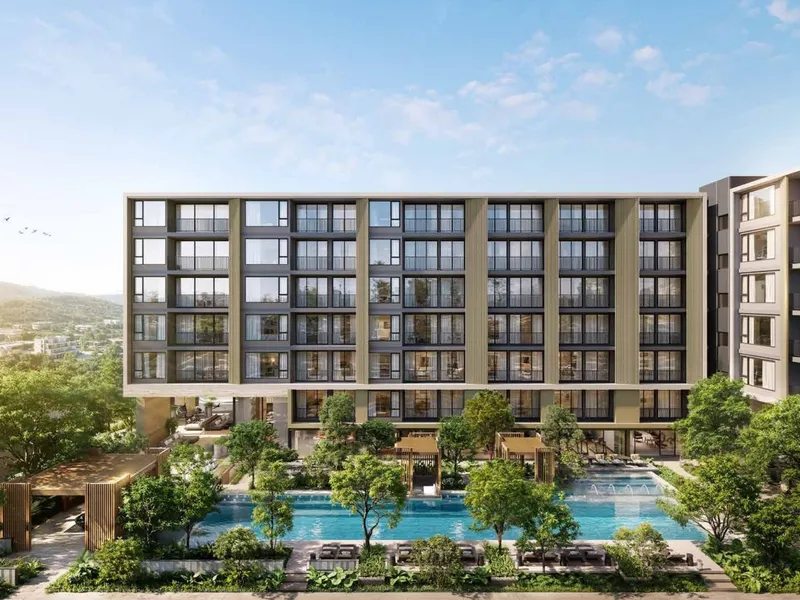 Developer render
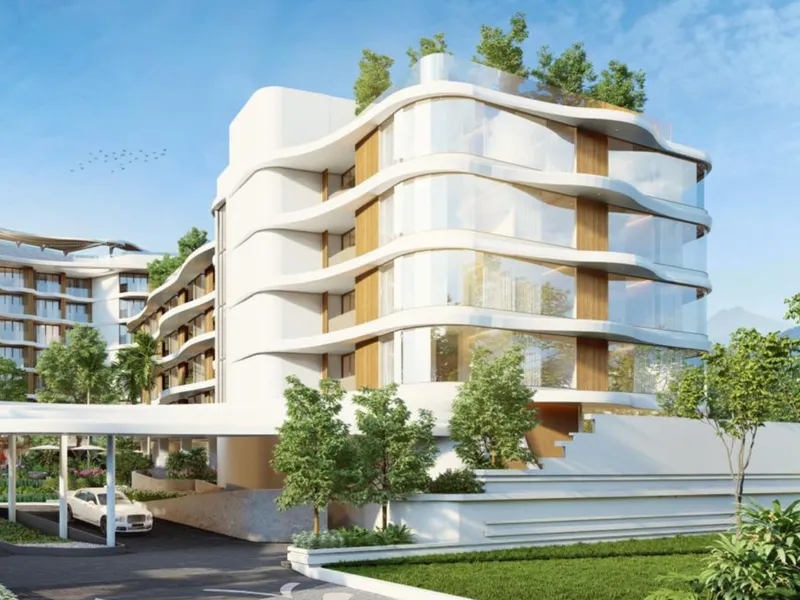 Developer render
.webp)
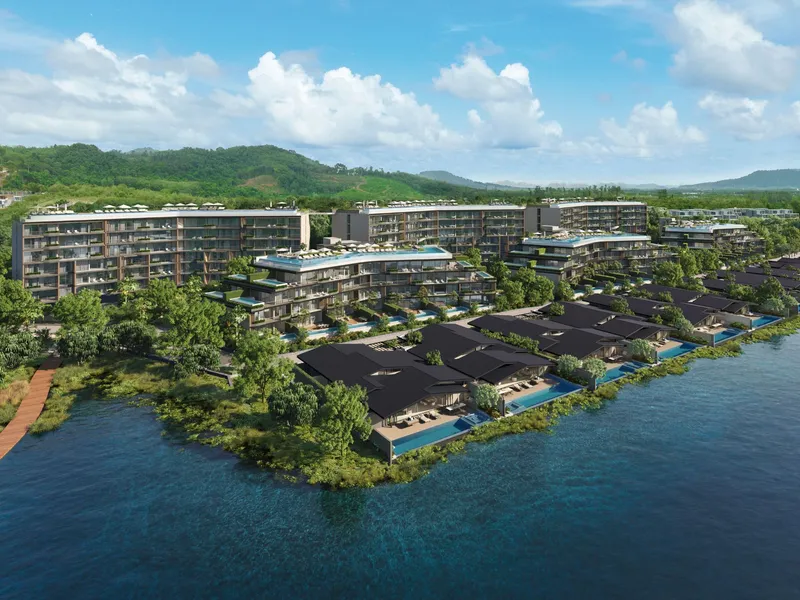 Developer render
In a registered condominium, foreign freehold ownership is capped at 49% of the total unit floor area. The remaining 51% is not automatically leasehold. A lease is a separate contractual structure; renewal wording should not be treated as an already registered extra term. For the usual foreign-currency purchase route, ask the receiving bank which evidence it will issue: an FET form or other applicable certificate. This evidence does not replace quota and title checks. The baseline ownership-transfer fee is 2% of the official appraisal; confirm the applicable rate and your share for the transaction.
The step-by-step buying guide covers the wider purchase process; the Phuket price guide and area guides compare the catalogue. Before paying a deposit, request the documents for the actual unit, including its ownership structure, payment schedule, fee table and any rental programme. A project brochure is not a substitute for those documents.
The programme table is retained from the 9 September 2026 edition and has not been recounted against updated profiles. The worked example and calculators describe inputs and arithmetic, not a client's achieved return.
There is no single honest number. Gross yield depends on entry price, seasonal occupancy and the operator; net yield further subtracts management commission, common-area fees, utilities, insurance and void periods. Treat any yield quoted before those inputs are known as a marketing figure, and model net cash flow on your own conservative assumptions before committing capital.
A developer or its management company contracts to pay the owner a fixed return for a set term, usually defined as a percentage of the purchase price, regardless of occupancy. The payments may be funded partly through a premium built into the price itself, and the promise is only as strong as the paying entity. Review who signs, what is netted from payments, owner-use limits, and what the unit earns after the term ends.
Yes. Foreigners may own freehold units in a registered condominium within the cap of 49% of total unit floor area. The remaining area is not necessarily leasehold. A villa requires separate checks on building and land rights; a condo purchase checklist cannot establish those rights.
The main statutory cost at transfer is the Land Office fee of 2% of the appraised value; how it is split between buyer and seller is a matter of contract. Beyond that, budget for a furniture package where not included, a one-off sinking-fund contribution and recurring common-area management fees. Exact amounts vary by project and are stated in the sale agreement.
Apartments dominate supply — 418 of the 571 Phuket listings in our catalogue — enter at lower prices and slot easily into rental programmes. Villas (148 listings) cost more, sit on leasehold or other land structures, and compete in the family and long-stay segment where nightly volume matters less. The right answer follows from your budget and chosen rental strategy, not the other way round.
Before sending money, ask the receiving bank for purchase-payment instructions and the evidence accepted for registration. For the usual foreign-currency route this may be an FET form or another bank certificate. Keep the documents and confirm requirements again with the bank when selling and transferring proceeds abroad.
Catalogue entry on Phuket starts at THB 2.1M, with the market median at THB 10.2M as of October 2026. Many developers accept staged payments up to handover, which spreads the outlay across the construction period instead of requiring the full amount at signing; schedules differ by project and we provide the actual tables on request.
We will answer your questions on this topic and send a shortlist of properties for your budget.