Laguna Beach Residences Seashore
photos on requestPrice on request
The enquiries that end in a purchase usually carry one thing the others do not: dates. "I arrive into Phuket on 6 July, so I am free on the 7th and 8th" is enough to build a programme around. Two days, a short list, a decision on the spot. Buyers who never name dates tend to be reading the same brochures a year later.
This guide covers the trip itself: how many properties fit into a day, how to sequence them across the island, what you can only judge in person, and what to ask a developer face to face. Contracts, deposits and title checks are a separate guide. Look first, sign later.
A viewing programme takes a few days to assemble. Sales offices keep their own hours, some units can only be shown with a site manager present, and a developer's finished buildings usually sit in a different district from the one under construction. Send your dates as soon as the flights are booked, and ideally before, while a day can still be moved.
Four is the ceiling if you are looking properly. By the fifth the floor plans merge, and the next morning you are comparing photographs on your phone again, which is exactly what you flew here to stop doing. A day covers one district well, or two adjacent ones badly.
The arithmetic follows: two or three districts, three or four properties a day, one district per day. That is two to three full days on the island, not counting the day you land.
Phuket runs north to south and has few through roads. Crossing the island costs real time, and in high season the approaches to Patong and Chalong cost more. Sort the shortlist by geography before you sort it by price.
| Day | Where you go | What fits |
|---|---|---|
| Arrival day | North, by the airport: Mai Khao, Nai Yang, Naithon | One property if you land in the morning. Evening arrival: none |
| Day 1 | West coast: Layan, Bang Tao, Cherng Talay, Surin | Three or four properties, plus the walk to the beach at each |
| Day 2 | Kamala, Patong, Kathu | Two or three, plus a finished building by the same developer |
| Day 3 | South: Chalong, Rawai, Nai Harn | Three. The drives between them run longer than on the west coast |
| Departure day | Phuket Town and Vichit, on the way to the airport | Urban developments, if the lower price bracket still interests you |
Treat that as a template, not a timetable. If only the west coast interests you, two days beat three: you get to see the same development in the morning and again at six in the evening, and they are not the same place.
Our Phuket catalogue holds 571 listings across 189 developments. Nobody sees that on one trip, so the shortlist is built before departure: district, budget, bedrooms, completion date. A few of them below.
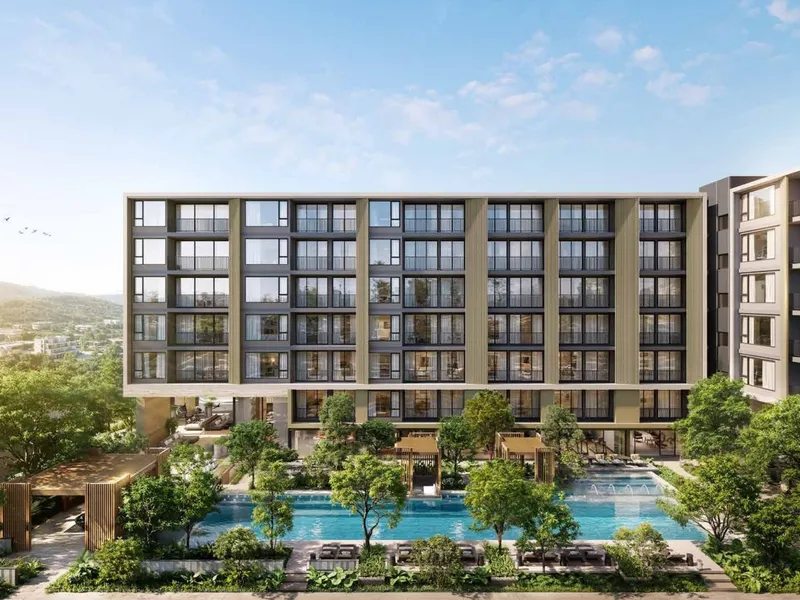 Developer render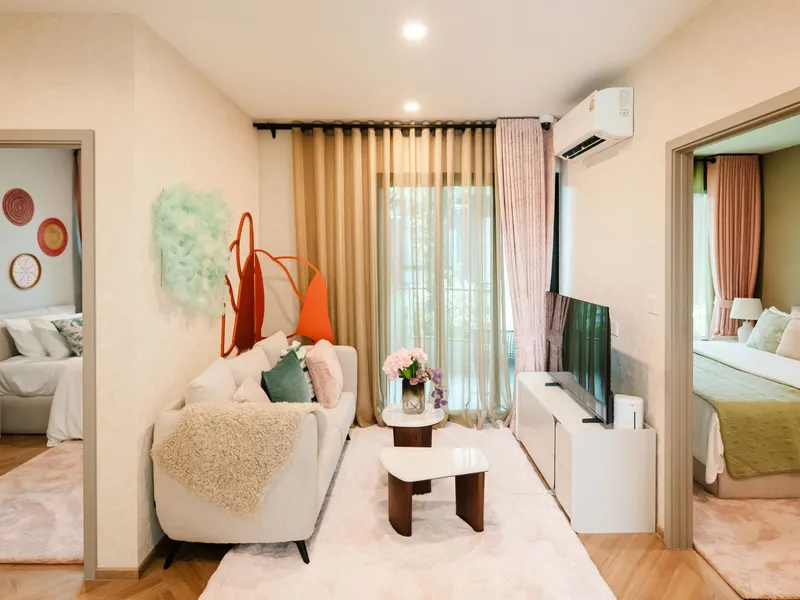
.webp)
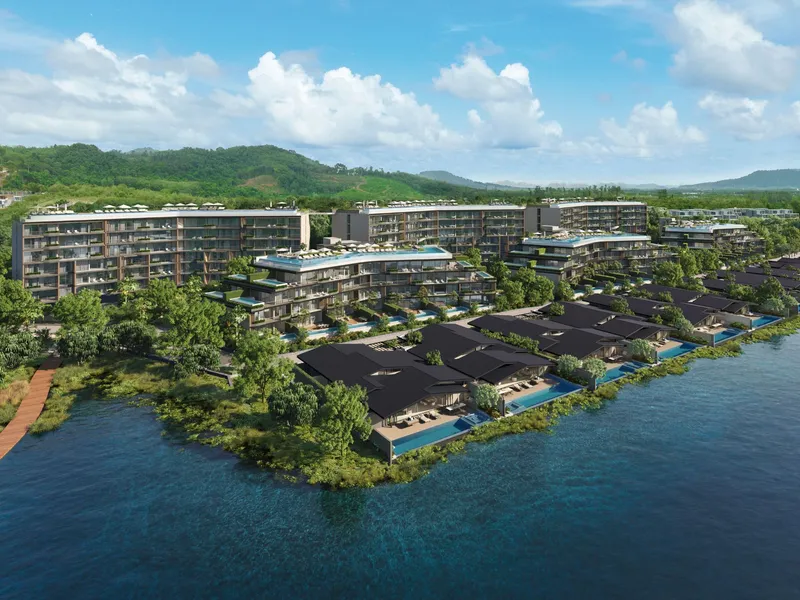 Developer render
Photographs are honest about geometry: size, layout, finish. Everything you will actually live with sits outside the frame.
Stand on the balcony and say nothing for two minutes. Road noise? Construction next door, and what is going up there, housing or a hotel? A pool below the window sounds different at seven in the evening than it does in a drone shot. In the north of the island add aircraft: approaches to the airport pass directly over Mai Khao beach. Check the building you are actually buying, not the one nearest the sales office.
Walk to the sea and time it on your phone. "Five minutes to the beach" is almost always a drive, or a straight line on a map, rather than a pavement in full sun with a climb on the way back. At the water, look at the colour and smell it: after rain some stretches of shore show run-off. From May to October the southwest monsoon works the west coast, lifeguards raise red flags, and a red flag means do not swim.
See the view from your floor, not from the roof and not from the neighbouring block. On a construction site ask to be taken to the level you are buying, or the nearest one that is safe. Then turn around and read the empty land nearby: hoardings, cleared ground, driven piles. Each of those says the view is temporary. Ask what may be built next door, and do not accept "that will be a park" as an answer.
American and Australian buyers often ask two opposite questions in one message: how close is the beach, and how high above the sea is the building. Both are answered on foot. Follow the evacuation route signs to see where they lead, watch where the ground starts to rise, and note where the access road dips. A development can be minutes from the sand and still sit well above it, and that combination is worth walking to confirm.
Arrive at a completed development in the afternoon, unannounced. Watch what security does with a stranger. Look at the lift, the car park and the bin store: management shows there long before it shows in the lobby. In the evening count the lit windows around you, which tells you whether people live here all year or only in season.
A show unit is assembled to be photographed. The furniture is often undersized, the paint is new, and the doors and hardware are not always the ones that go into production. Ask to see a building the same developer completed several years ago, and walk through it.
The most honest test available is to rent in the development for a few days and live there. Buyers work this out on their own: they find a short let in the same building, or in the developer's neighbouring project, and move in. Three days answer questions no viewing can.
One side effect is worth expecting: some developments drop off the list afterwards. That is a cheap result next to reaching the same conclusion a year after completion.
From May to October the southwest monsoon sits over Phuket. Rain usually falls for an hour or two in the afternoon or early evening rather than all day, but the west-coast sea turns rough and the red flags go up.
Coming once: pick the dry months, because that is the season the property has to perform in. Coming twice: put the second trip in a wet month and watch the drainage.
A sales meeting moves faster when the questions are written down. Agents answer what they are asked, and what nobody asks stays out of the presentation.
Write the answers down as you go. After three days and six developments you will not remember who included the air conditioning. Photograph the building-number signs as well as the views, or the pictures on your phone become indistinguishable.
Phuket is reached by air into the airport in the north of the island, by road across the Sarasin bridge, or by sea through the ferry piers and marinas. Most buyers fly, which puts the northern districts closest to the terminal. Around the island you will use ride-hailing, a rental car or a car with a driver; whichever it is, put the driving into the plan as its own line. Hops between neighbouring west-coast districts are short, while going north to south and back takes a large part of the day.
Video is worse than your own eyes and better than a render. We film projects ourselves during site visits: construction progress, show units, floor views, uncut. Accompanied viewings, show units and construction sites included, are part of what we do. Send your dates early and the shortlist waiting for you will be short and grouped by geography.
Two or three full days for two or three districts. Two nights can work, but then stay on one stretch of coast and cap it at four properties: crossing the island will eat half the time you have.
Yes, and it works better that way. Send arrival and departure dates, the days you are free in between, your budget and one or two districts. Sales offices keep their own hours and some units need a site manager present, so a programme assembled in advance loses no half-days.
One property at most, and near the airport: Nai Yang, Naithon, Mai Khao. Attention after a long flight is poor, and the first development you see sets the bar for every one after it.
You come as a tourist, and buying property does not require a separate status. Entry rules depend on your nationality and change from time to time, so check the official Thai visa portal before booking flights.
Yes, and it is the best test there is. Find a short let in the same building or in the developer's neighbouring project, and take at least three days. One night tells you nothing about the morning noise or the evening pool.
For a second trip, yes. Low season shows the drainage, the roads after a downpour and the real occupancy of the buildings around you. If you only come once, come in the dry months, because that is the season your property has to earn in.
No. Write down what failed in each development: road noise, the beach being further than it looked, neighbours all on nightly lets. Those sentences narrow a search faster than the wish list you started with, and the next trip will be shorter.
We will answer your questions on this topic and send a shortlist of properties for your budget.